Streamline Flat Ribbon Design with Vector Brushes
There is a specific kind of friction that every graphic designer knows well. You have a clear vision for a layout—perhaps a badge for a new product launch, a celebratory banner for a blog post, or a sleek icon for a mobile app. You know exactly where a ribbon element would tie the composition together, adding that necessary touch of depth and movement. But then comes the tedious reality of building it from scratch. You spend twenty minutes manipulating anchor points, trying to get the fold logic right, wrestling with gradient meshes to simulate light and shadow, only to end up with something that looks stiff or overly complicated. In the fast-paced world of web design and digital marketing, time spent drawing basic geometric forms is time stolen from strategy and storytelling.
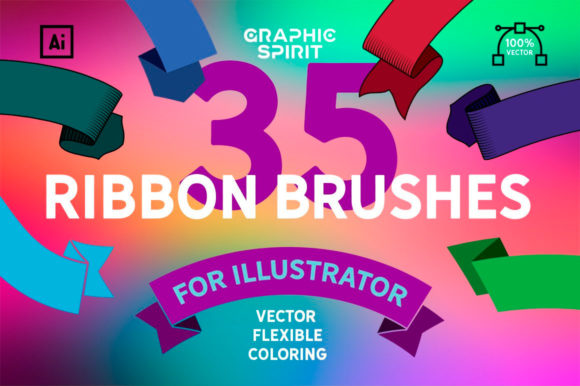
This is where the utility of Vector Ribbon Brushes Illustrator transforms the workflow. These aren't just decorative strokes; they are intelligent design assets engineered to replicate the physics of folded paper or fabric within a flat design aesthetic. The core appeal lies in their simplicity and efficiency. Instead of constructing a complex shape layer by layer, the process is reduced to its absolute essentials: draw a curve, select a color, and apply the brush. The software instantly generates the ribbons, complete with the necessary shading and highlights that give the illusion of three-dimensionality. This automation allows designers to focus on the curvature and flow of the line rather than the mechanics of the fold.
The Aesthetic of Modern Flat Design
The visual personality of these brushes is rooted in the "flat 2.0" or semi-flat style that has dominated modern typography and interface design for the last decade. Unlike the glossy, beveled skeuomorphic trends of the early 2000s, these ribbons rely on subtle shifts in tone to create depth. They possess a clean, crisp edge that scales perfectly from a tiny favicon to a massive trade show banner. Because they are vector-based, there is no pixelation, ensuring that the brand identity remains sharp across all devices.
What makes this specific set of tools so effective is how they handle light. When you apply a brush stroke, the darker shades representing the underside of the fold and the lighter highlights on the crest appear automatically. This consistency is crucial for maintaining professional standards. When you are creating a suite of social media graphics or a series of instructional icons, having a uniform lighting source across all ribbon elements creates a cohesive visual language. It signals to the audience that the content is polished and thoughtfully produced, rather than cobbled together from disparate clip-art sources.
Furthermore, the style is versatile enough to bridge the gap between playful and corporate. A bright, saturated color palette can make the ribbons feel energetic and suitable for a children's app or a festival poster. Conversely, using muted tones or monochromatic schemes can elevate the same shapes for use in editorial design or high-end packaging design. The brushes adapt to the context provided by the surrounding typeface and imagery, acting as a supportive element that enhances rather than overwhelms the primary message.
Practical Applications Across Industries
The versatility of these vector tools extends far beyond simple decoration. For logo design, they offer a quick way to incorporate dynamic movement into a static mark. Imagine a consultancy firm wanting to suggest progress or a non-profit needing a symbol of connection; a flowing ribbon created with these brushes can serve as the foundational structure of the logo, wrapping around text or framing an icon. Because the file includes versions compatible with both Adobe Illustrator CC and older CS3-CS6 iterations, these assets are accessible to freelancers working with varied client setups and legacy systems.
In the realm of web design and UI/UX, these ribbons function excellently as call-to-action indicators or section dividers. They can guide the user's eye down a landing page, highlighting key features or testimonials without the heavy load time associated with raster images. For marketers and content creators, the speed of deployment is a game-changer. You can iterate through five different layout variations in the time it used to take to build one. This agility allows for rapid A/B testing of visual elements to see what resonates best with the target audience.
Publishers and bloggers will find immense value in using these brushes for header graphics and pull quotes. A ribbon wrapping around a headline instantly establishes a visual hierarchy, telling the reader, "This is important." It breaks up the monotony of standard text blocks and adds a layer of editorial flair that feels custom-made. Even for small business owners handling their own branding, these tools lower the barrier to entry, allowing them to produce marketing materials that look like they came from a dedicated design team.
Maximizing Workflow and Visual Hierarchy
To get the most out of Vector Ribbon Brushes Illustrator, it is essential to understand how they interact with other design elements. While the brushes handle the shading automatically, the designer still controls the narrative through line weight and curvature. A tight, sharp curve suggests energy and urgency, while a long, sweeping arc implies elegance and calm. When pairing these graphical elements with text, consider the balance. If you are using a bold sans serif font for your headlines, a thick ribbon stroke often complements the weight of the letters. If your copy relies on a delicate serif font or a script font, a thinner, more graceful ribbon path will maintain the sophisticated tone.
Readability and accessibility should always remain top priorities. While the automatic shading is convenient, ensure that the contrast between the ribbon colors and the text placed over them (if any) meets WCAG guidelines. Sometimes, the generated shadows might need a slight opacity adjustment depending on the background color of your project. The included AI files provide 35 distinct variations, offering a wide range of widths and fold styles. This variety prevents the "cookie-cutter" look; by mixing different brush styles within a single project, you can create a rich, textured environment that feels organic rather than repetitive.
From a technical standpoint, these brushes streamline the file management process. Because everything remains editable vector paths, you can easily recolor the entire asset to match a client's brand guidelines with a single click. There is no need to hunt down layered PSD files or rasterized PNGs with white backgrounds that are a nightmare to remove. The clean geometry ensures that when you export to SVG for the web or PDF for print, the lines remain mathematically perfect. This level of precision reinforces professionalism and ensures that the final output looks consistent whether viewed on a retina display or a printed brochure.
Ultimately, the value of these design assets lies in what they free you to do. By automating the mechanical process of drawing folds and shadows, Vector Ribbon Brushes Illustrator returns your focus to the creative problems that actually matter: composition, color theory, and message clarity. Whether you are a seasoned art director or a hobbyist crafter looking to digitize your invitations, these tools provide a reliable foundation for creating engaging, high-quality visuals that stand out in a crowded digital landscape.